Meowdoku Level 582 Answer
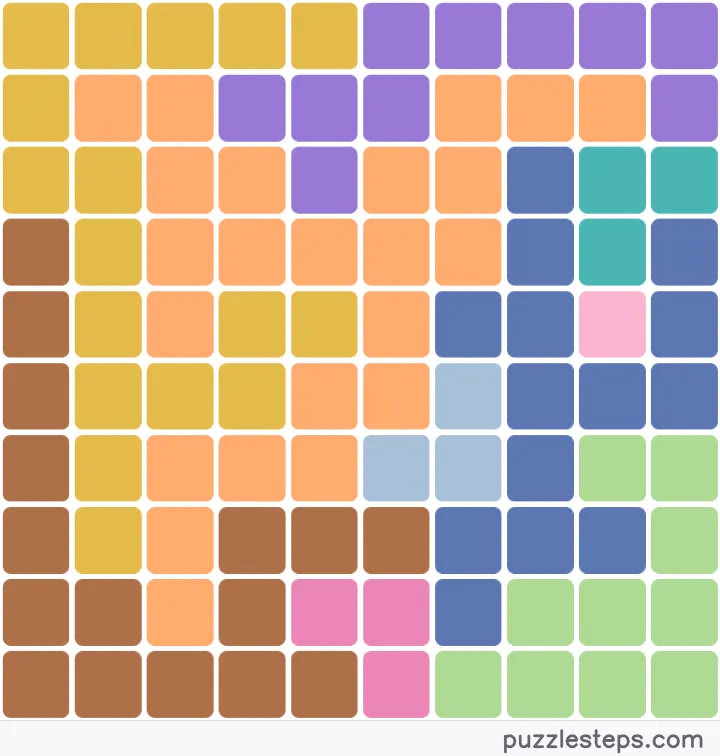
Board info
- Size
- 10×10
- Color regions
- 10
- Pre-placed cats
- none
- Difficulty
- ★★★☆☆
- Techniques used
- T1 Neighbor eliminationT2 Unit clearingT3 Last free cellT4 Single lockT5 Multi lock
10×10 board with 10 color regions and no pre-placed cats. Difficulty: 3/5 stars. Techniques used: T1 Neighbor elimination, T2 Unit clearing, T3 Last free cell, T4 Single lock, T5 Multi lock.
Show hint
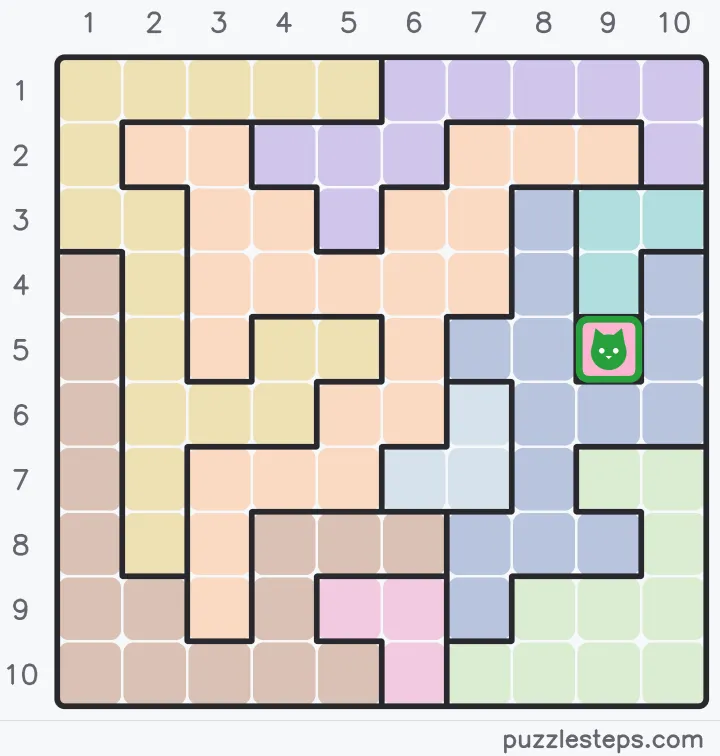
Hint: The light pink region has only one cell left that can hold a cat, so the cat goes to R5C9.
Blue outline = cells the reasoning looks at, red = the cell(s) to cross out, green = where the cat goes.
Show full answer
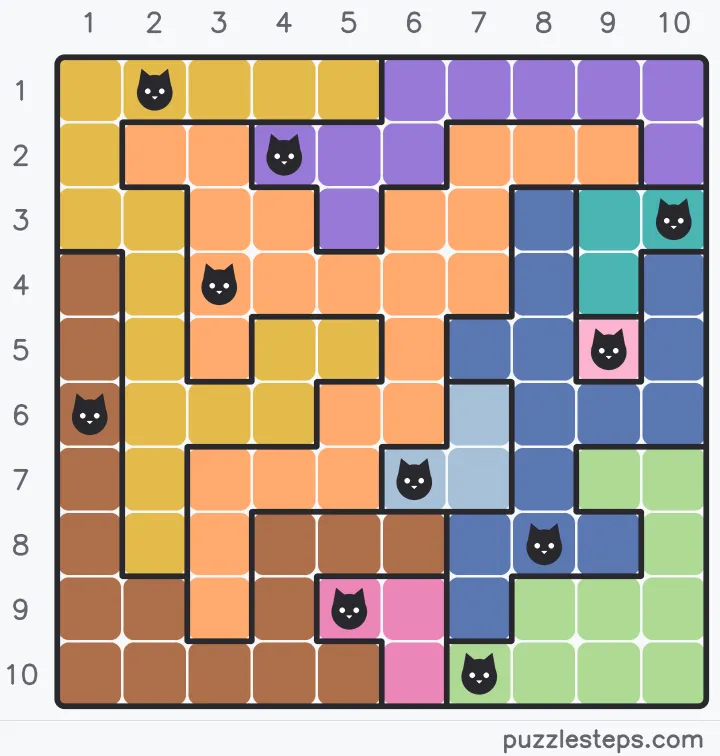
Cats go in: R1C2, R2C4, R3C10, R4C3, R5C9, R6C1, R7C6, R8C8, R9C5, R10C7
R = row (top to bottom), C = column (left to right). R1C1 is the top-left cell.
Step-by-step solution
R = row (top to bottom), C = column (left to right). R1C1 is the top-left cell.
Opening
- The light pink region has only one cell left that can hold a cat, so the cat goes to R5C9. Then cross out its neighbors and the rest of row 5 and column 9 (22 cells).
- The teal region has only one cell left that can hold a cat, so the cat goes to R3C10. Then cross out its neighbors and the rest of row 3 and column 10 (14 cells).
Middle game
- The 2 regions the light green region and the pink region only have candidates in rows 9 and 10. Those 2 lines are therefore used up by these regions, so every other cell in rows 9 and 10 is X: 10 cells.
- The candidates of columns 2 and 3 lie in only 2 regions: the yellow region and the orange region. Those regions must take their cats from these lines, so their other cells are X: 15 cells.
- All remaining candidates of column 1 lie inside the brown region, so the brown region must get its cat from column 1; cross out the rest of that region: 3 cells (R8C4, R8C5, R8C6).
Endgame
- Column 4 has only one cell left that can hold a cat, so the cat goes to R2C4. Then cross out its neighbors and the rest of row 2 and the purple region (8 cells).
- Row 1 has only one cell left that can hold a cat, so the cat goes to R1C2. Then cross out the rest of column 2 and the yellow region (5 cells).
- Column 5 has only one cell left that can hold a cat, so the cat goes to R9C5. Then cross out its neighbors and the rest of row 9 (3 cells).
- Column 6 has only one cell left that can hold a cat, so the cat goes to R7C6. Then cross out its neighbors and the rest of row 7 (6 cells).
- The dark blue region has only one cell left that can hold a cat, so the cat goes to R8C8. Then cross out the rest of row 8 and column 8 (3 cells).
- The orange region has only one cell left that can hold a cat, so the cat goes to R4C3. Then cross out the rest of row 4 (1 cell).
- The brown region has only one cell left that can hold a cat, so the cat goes to R6C1.
- The light green region has only one cell left that can hold a cat, so the cat goes to R10C7.
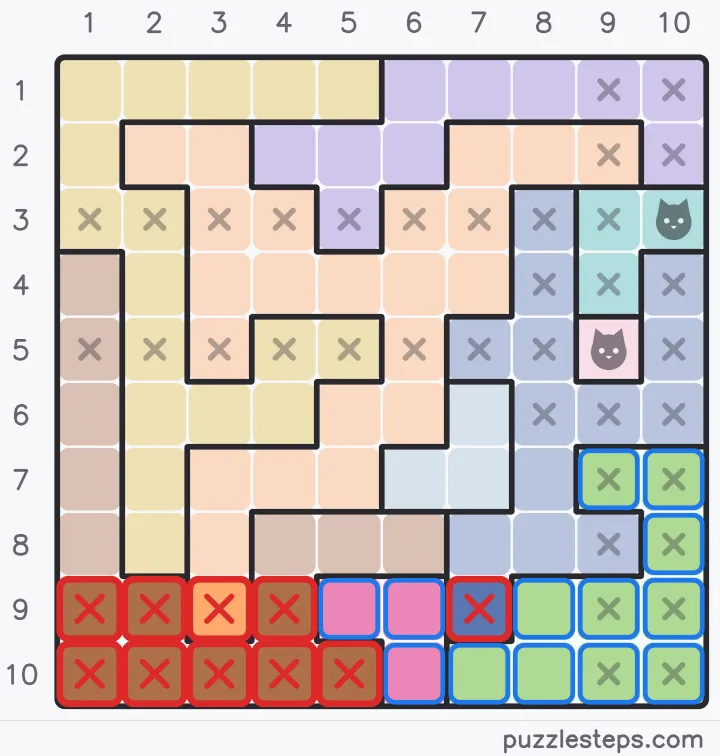
The 2 regions the light green region and the pink region only have candidates in rows 9 and 10. Those 2 lines are therefore used up by these regions, so every other cell in rows 9 and 10 is X: 10 cells.
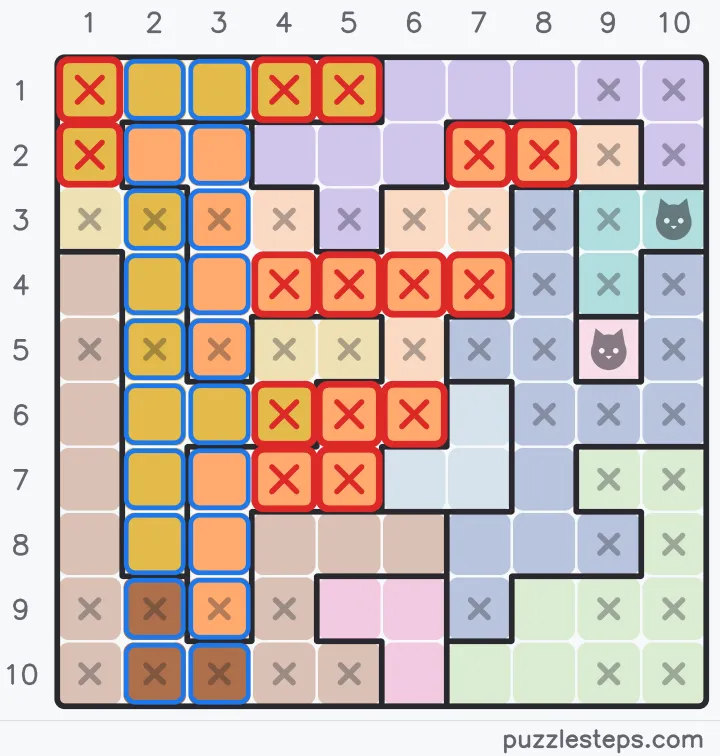
The candidates of columns 2 and 3 lie in only 2 regions: the yellow region and the orange region. Those regions must take their cats from these lines, so their other cells are X: 15 cells.
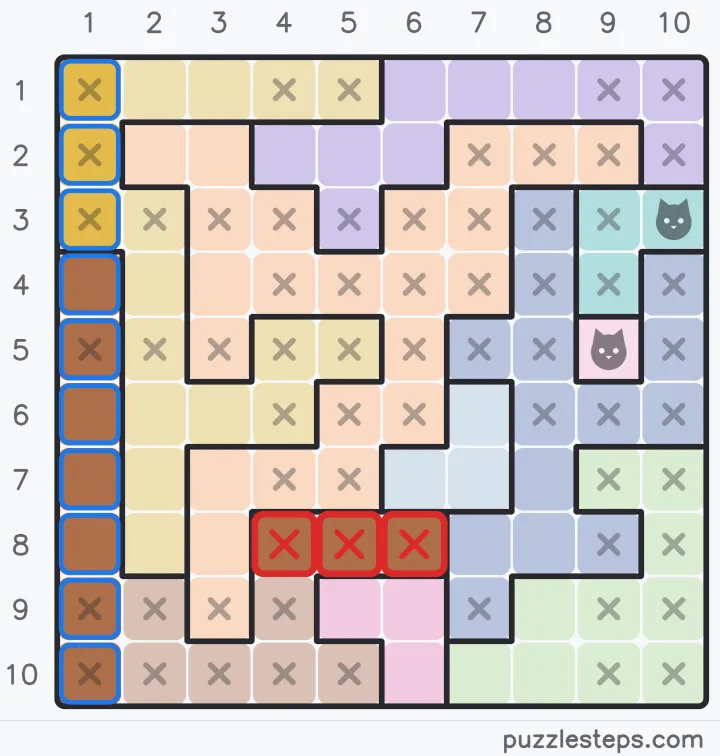
All remaining candidates of column 1 lie inside the brown region, so the brown region must get its cat from column 1; cross out the rest of that region: 3 cells (R8C4, R8C5, R8C6).
Blue outline = cells the reasoning looks at, red = the cell(s) to cross out, green = where the cat goes.