Meowdoku Level 320 Answer
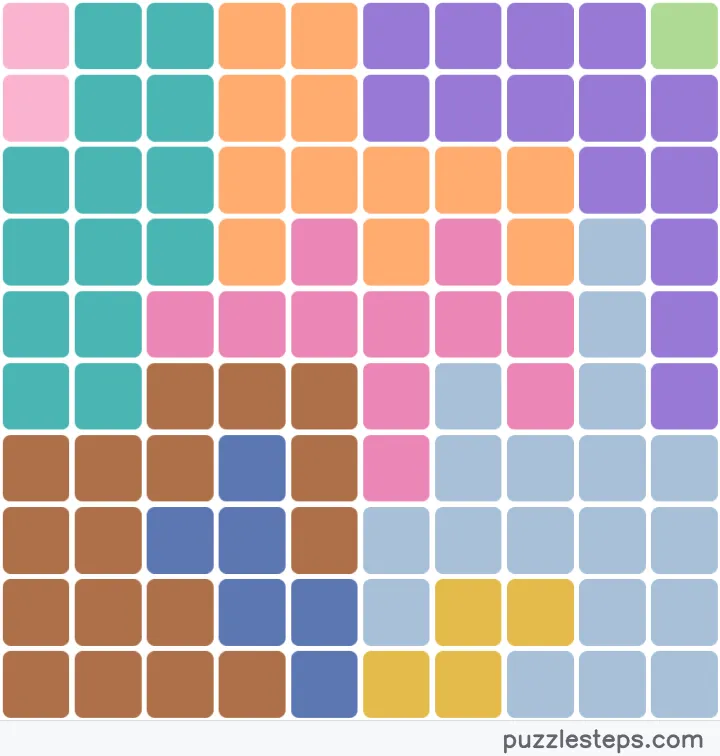
Board info
- Size
- 10×10
- Color regions
- 10
- Pre-placed cats
- none
- Difficulty
- ★★★★☆
- Techniques used
- T1 Neighbor eliminationT2 Unit clearingT3 Last free cellT4 Single lockT5 Multi lockT6 Common neighborT7 Lookahead
10×10 board with 10 color regions and no pre-placed cats. Difficulty: 4/5 stars. Techniques used: T1 Neighbor elimination, T2 Unit clearing, T3 Last free cell, T4 Single lock, T5 Multi lock, T6 Common neighbor, T7 Lookahead.
Show hint
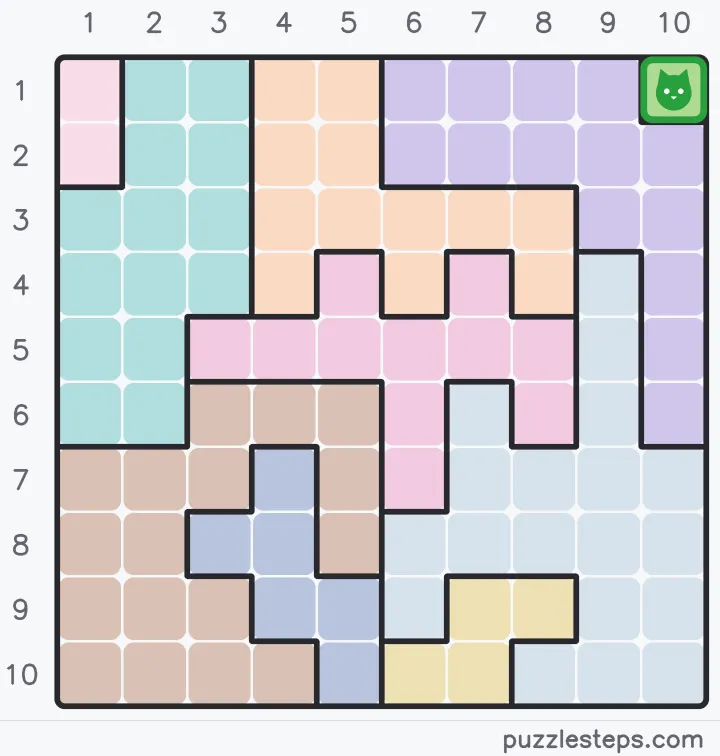
Hint: The light green region has only one cell left that can hold a cat, so the cat goes to R1C10.
Blue outline = cells the reasoning looks at, red = the cell(s) to cross out, green = where the cat goes.
Show full answer
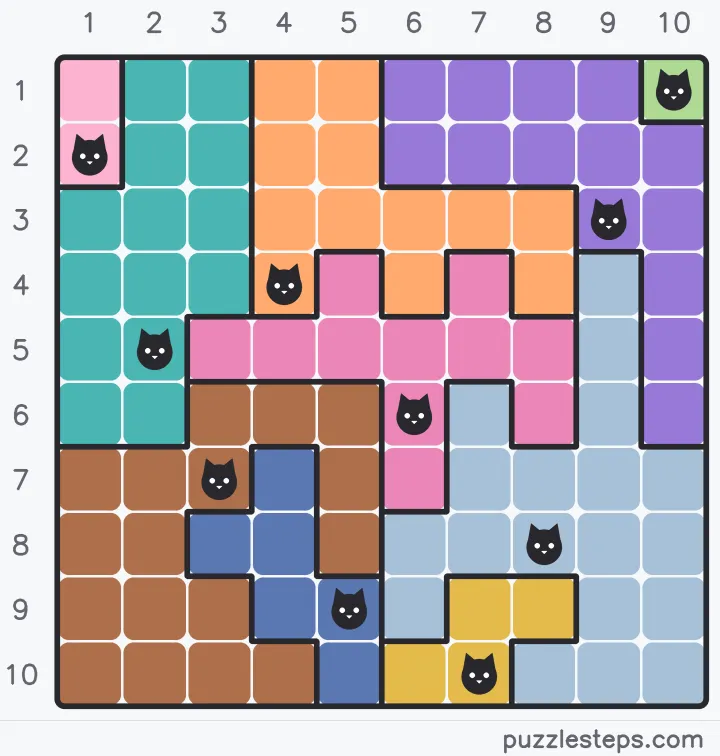
Cats go in: R1C10, R2C1, R3C9, R4C4, R5C2, R6C6, R7C3, R8C8, R9C5, R10C7
R = row (top to bottom), C = column (left to right). R1C1 is the top-left cell.
Step-by-step solution
R = row (top to bottom), C = column (left to right). R1C1 is the top-left cell.
Opening
- The light green region has only one cell left that can hold a cat, so the cat goes to R1C10. Then cross out its neighbors and the rest of row 1 and column 10 (19 cells).
- The light pink region has only one cell left that can hold a cat, so the cat goes to R2C1. Then cross out its neighbors and the rest of row 2 and column 1 (16 cells).
- The purple region has only one cell left that can hold a cat, so the cat goes to R3C9. Then cross out its neighbors and the rest of row 3 and column 9 (14 cells).
Middle game
- Every remaining candidate of the orange region lies in row 4, so that line's cat must belong to the orange region; cross out the rest of row 4: 4 cells (R4C2, R4C3, R4C5, R4C7).
- Every remaining candidate of the teal region lies in column 2, so that line's cat must belong to the teal region; cross out the rest of column 2: 4 cells (R7C2, R8C2, R9C2, R10C2).
- Every remaining candidate of the teal region (R5C2, R6C2) attacks 2 cells (R5C3, R6C3): whichever candidate gets the cat, those cells cannot hold one, so mark them X.
- Every remaining candidate of the orange region (R4C4, R4C6) attacks R5C5: whichever candidate gets the cat, those cells cannot hold one, so mark them X.
- The candidates of columns 3 and 5 lie in only 2 regions: the brown region and the dark blue region. Those regions must take their cats from these lines, so their other cells are X: 5 cells (R6C4, R7C4, R8C4, R9C4, R10C4).
- Every remaining candidate of the dark blue region (R8C3, R9C5, R10C5) attacks R8C5: whichever candidate gets the cat, those cells cannot hold one, so mark them X.
- Every remaining candidate of the yellow region (R9C7, R9C8, R10C6, R10C7) attacks 2 cells (R9C6, R10C8): whichever candidate gets the cat, those cells cannot hold one, so mark them X.
- Suppose a cat were at R6C5: the teal region and the pink region would then fit into fewer than 2 rows, which is impossible. So R6C5 is X.
- Suppose a cat were at R6C7: the teal region and the pink region would then fit into fewer than 2 rows, which is impossible. So R6C7 is X.
- The candidates of rows 5 and 6 lie in only 2 regions: the teal region and the pink region. Those regions must take their cats from these lines, so their other cells are X: R7C6.
- Suppose a cat were at R7C5: the gray-blue region and the dark blue region would then fit into fewer than 2 rows, which is impossible. So R7C5 is X.
- Every remaining candidate of the brown region lies in column 3, so that line's cat must belong to the brown region; cross out the rest of column 3: R8C3.
- All remaining candidates of row 8 lie inside the gray-blue region, so the gray-blue region must get its cat from row 8; cross out the rest of that region: 2 cells (R7C7, R7C8).
- Row 7 has only one cell left that can hold a cat, so the cat goes to R7C3. Then cross out its neighbors and the rest of column 3 (3 cells).
- The teal region has only one cell left that can hold a cat, so the cat goes to R5C2. Then cross out the rest of row 5 (4 cells).
- Column 4 has only one cell left that can hold a cat, so the cat goes to R4C4. Then cross out the rest of row 4 (1 cell).
- Every remaining candidate of the gray-blue region (R8C6, R8C7, R8C8) attacks R9C7: whichever candidate gets the cat, those cells cannot hold one, so mark them X.
- Every remaining candidate of the dark blue region (R9C5, R10C5) attacks R10C6: whichever candidate gets the cat, those cells cannot hold one, so mark them X.
- Every remaining candidate of the yellow region (R9C8, R10C7) attacks R8C7: whichever candidate gets the cat, those cells cannot hold one, so mark them X.
Endgame
- Column 7 has only one cell left that can hold a cat, so the cat goes to R10C7. Then cross out its neighbors and the rest of row 10 (2 cells).
- The dark blue region has only one cell left that can hold a cat, so the cat goes to R9C5. Then cross out its neighbors (1 cell).
- The gray-blue region has only one cell left that can hold a cat, so the cat goes to R8C8. Then cross out the rest of column 8 (1 cell).
- The pink region has only one cell left that can hold a cat, so the cat goes to R6C6.
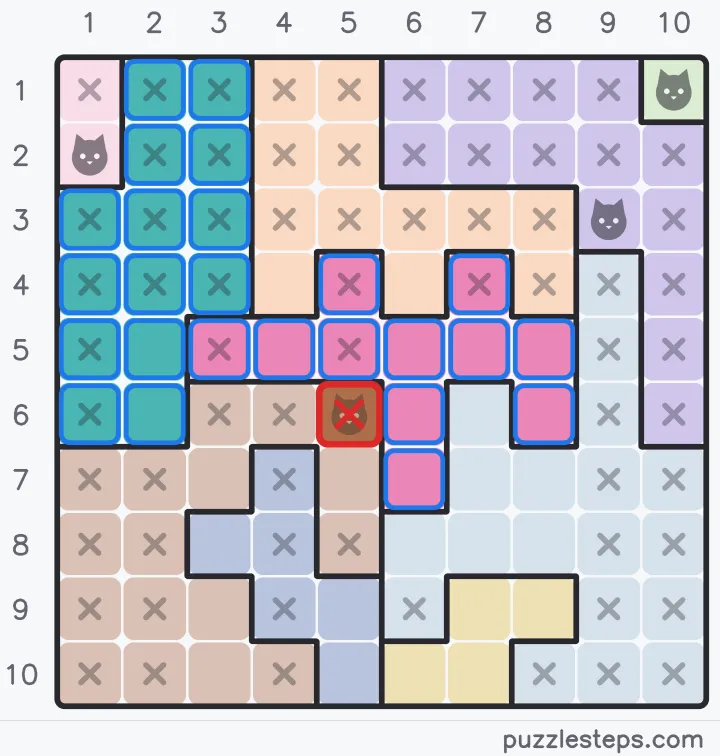
Suppose a cat were at R6C5: the teal region and the pink region would then fit into fewer than 2 rows, which is impossible. So R6C5 is X.
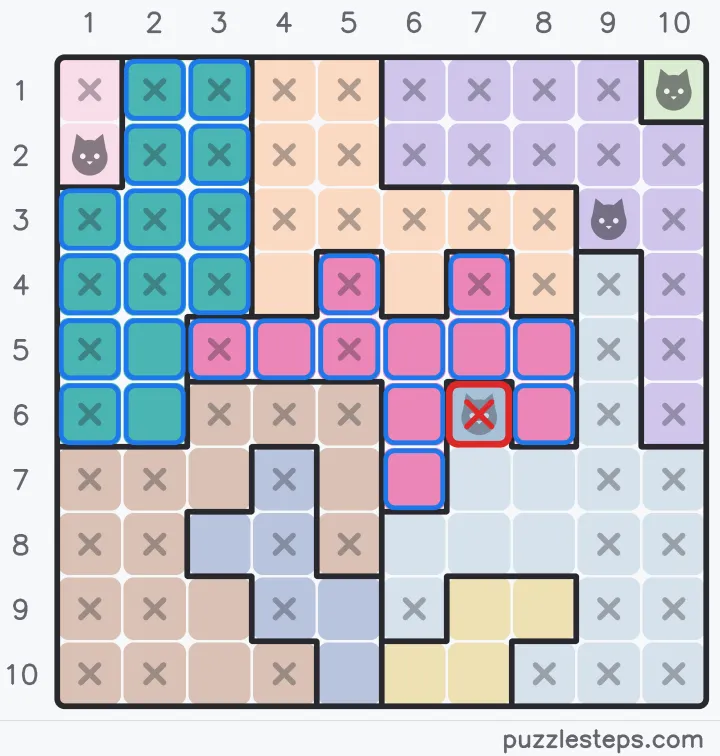
Suppose a cat were at R6C7: the teal region and the pink region would then fit into fewer than 2 rows, which is impossible. So R6C7 is X.
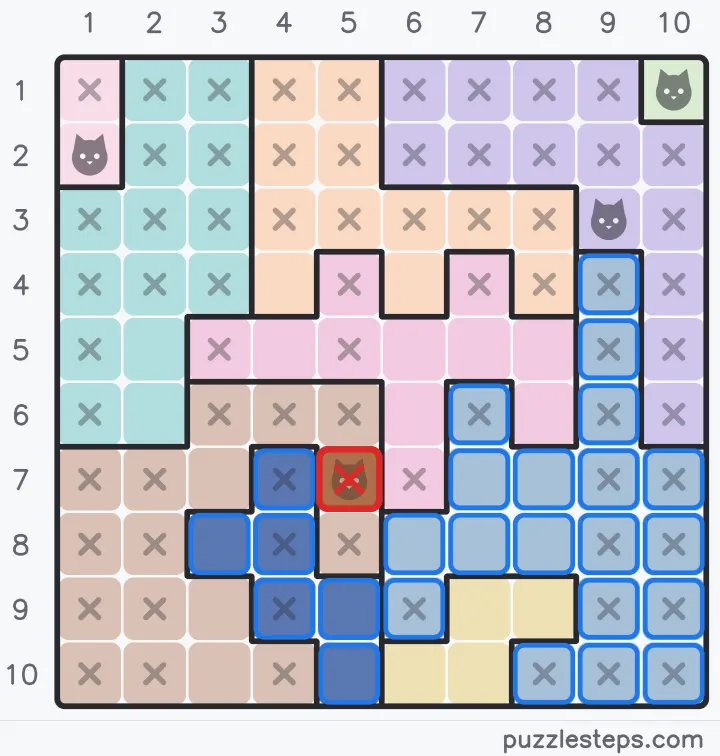
Suppose a cat were at R7C5: the gray-blue region and the dark blue region would then fit into fewer than 2 rows, which is impossible. So R7C5 is X.
Blue outline = cells the reasoning looks at, red = the cell(s) to cross out, green = where the cat goes.